As businesses grow, customer data is often stored across multiple systems: Sales CRM, customer service platforms, Marketing software, websites, stores, applications, or internal files. Each department may have access to part of the information, but they do not always have a complete view of the same customer’s journey.
This is the challenge that Customer 360 aims to address. Instead of managing customer information separately across different systems or departments, businesses can build a unified view that connects relevant data and interactions to create a more comprehensive customer profile.
What Is Customer 360?
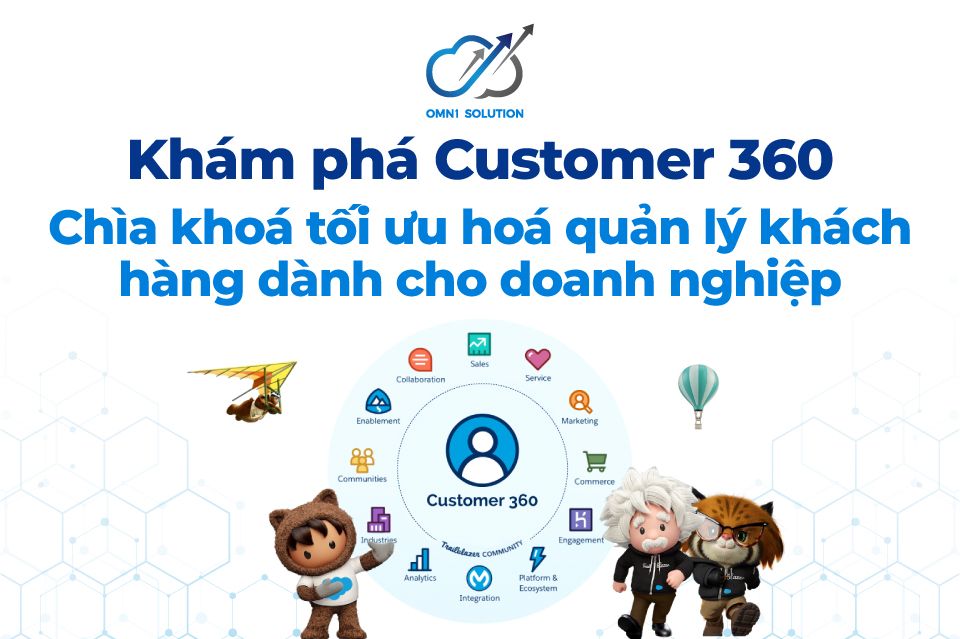
Customer 360 is an approach to creating a unified view of customers across all touchpoints. According to Salesforce, Customer 360 connects data and applications supporting Sales, Marketing, Service, Commerce, and other business activities, allowing teams to work with a shared source of customer information.
For example, a customer may submit information through a website, receive Sales consultation, make a purchase, submit a support request, and continue receiving Marketing campaigns. If this data is stored in separate systems, each department can only see part of the customer’s history. With Customer 360, these data points can be connected to provide a more complete picture of the customer.
Importantly, Customer 360 is not simply about putting all data in one place. Businesses also need to standardize data, match customer identities, and establish relationships between different data points to reduce duplicate profiles and inconsistent information.
Why Do Vietnamese Businesses Need Customer 360?
As many businesses expand from a single sales channel to multiple channels, customer data can easily become fragmented. The same customer may appear under different IDs across the CRM, website, sales system, or customer service platform.
When data is not connected, Sales may not know that a customer has recently submitted a support request, Marketing may continue sending irrelevant content, while Customer Service may have to ask for information that the customer has already provided. The issue is not limited to customer experience; it can also affect the business’s ability to use data for upselling, customer care, and retention.
Customer 360 allows different teams to work with the same customer context, supporting more personalized interactions and better cross-functional collaboration.
What Do Businesses Need to Build Customer 360?
1. Identify Where Customer Data Is Stored
Before implementing technology, businesses need to map their existing data sources. These may include CRM, ERP, websites, POS systems, Marketing platforms, contact centers, email, applications, or Excel files.
The goal of this step is to understand what data is being used, who owns it, and which systems need to be connected.
2. Standardize Data
Different systems often use different field names, customer IDs, or data formats. Businesses need to establish consistent standards for core information such as names, phone numbers, email addresses, customer IDs, transaction history, and interaction records.
This provides the foundation for reducing situations where the same customer is represented by multiple profiles.
3. Connect and Unify Data
After standardizing the data, businesses need to connect relevant sources and establish rules for identifying the same customer across systems. Salesforce Data 360, formerly known as Data Cloud, supports the connection of structured and unstructured data, data standardization, identity resolution, and the creation of unified profiles from multiple sources.
This allows businesses to build a unified customer profile instead of managing individual records separately.
4. Put Customer Data into Business Processes
Customer 360 only creates value when the data is actually used in day-to-day operations. Sales teams can review interaction history before approaching a customer; Marketing teams can create segments based on customer behavior; Customer Service teams can access purchase history and previous support requests.
When unified data is brought back into these processes, businesses can move from simply “storing data” to actually “taking action based on data.”
Where Should Businesses Start with Customer 360?
Vietnamese businesses do not necessarily need to connect every system at once. A more practical approach is to start with a specific business problem, such as unifying Sales and Customer Service data, and then gradually expand to Marketing, Commerce, or other data sources.
The most important step is to clearly define what Customer 360 is expected to solve, which data is actually needed, and which teams will use the resulting information. With a controlled scope, businesses can gradually improve their data model instead of launching a large-scale project that is difficult to measure.
Conclusion
Customer 360 is more than a customer management system. It is an approach to connecting data, people, and processes around a unified view of each customer. For Vietnamese businesses that are expanding across multiple channels and accumulating increasing amounts of data, Customer 360 can provide an important foundation for improving customer experience and making better use of customer information.
Rather than starting by purchasing another tool, businesses should begin with the data they already have, the business problems they need to solve, and how different teams will use that information. From this foundation, Customer 360 can evolve into a data environment that genuinely supports business growth.