Launching the “Salesforce CRM Phase 2 for British University Vietnam (BUV)” Project: Advancing Admissions Operations Through Data and Performance
As higher education enters an increasingly competitive era, universities are no longer focused solely on academic excellence. Institutions are also investing heavily in building agile, data-driven operational capabilities with long-term scalability. For international education organizations in particular, student experience and decision-making speed have become critical factors in sustaining competitive advantage.
As the first university in Vietnam to award degrees directly from the United Kingdom, British University Vietnam (BUV) has consistently pioneered the adoption of international standards across education — from academic programs and faculty quality to governance and operational models.
Continuing its long-term growth strategy and responding to expanding enrollment demands, BUV has officially launched the “Salesforce CRM Phase 2” project in partnership with OMN1 Solution. The project marks a significant transition from digitized admissions operations toward a performance- and data-driven admissions management model.
Salesforce CRM Phase 2: Elevating Admissions Operations at the Management Level
The “Salesforce CRM Phase 2 for British University Vietnam (BUV)” project is designed not only to improve workflows, but also to enhance BUV’s overall admissions management capabilities.
Implemented in collaboration with OMN1 Solution — one of Vietnam’s leading Salesforce partners — the project is built around several key strategic directions.
1. Redesigning Admissions Operations with an “Orchestrated Workflow” Model
In modern admissions environments, the student journey can no longer rely on disconnected tasks across departments. Instead, every activity needs to be connected within a unified operational process that enables seamless collaboration and real-time responsiveness.
For this reason, one of the project’s primary focuses is redesigning admissions operations using an “Orchestrated Workflow” model, where admissions, marketing, and student engagement processes are tightly connected on a single operational platform.
This model enables BUV to:
- Strengthen alignment between admissions, marketing, and student engagement teams
- Reduce information gaps across different stages
- Standardize workflows across the organization
- Improve response speed and operational efficiency for prospective student requests
At the same time, this approach lays the foundation for future automation and personalized admissions experiences.
2. Enhancing Real-Time Cross-Department Collaboration
As admissions scale expands, collaboration between departments becomes increasingly important in maintaining operational efficiency and delivering a seamless student experience.
However, in operational environments involving multiple touchpoints, fragmented data, and complex processes, inconsistent information updates across departments can create delays and negatively impact overall performance.
To address this, Salesforce CRM Phase 2 focuses on strengthening real-time collaboration through a centralized and synchronized data system across the entire admissions workflow.
The upgraded system enables:
- Instant synchronization of statuses and data across teams
- Real-time tracking of operational progress and performance
- Reduced dependence on manual communication and fragmented data sources
- Greater operational transparency between departments
By connecting data and workflows within a unified CRM platform, BUV can improve not only internal collaboration but also management-level operational coordination. Leadership teams and department heads gain real-time visibility into admissions performance, enabling faster identification of operational bottlenecks and more informed decision-making based on continuously updated data.
3. Shifting from Task Management to Performance Management
Another major focus of Salesforce CRM Phase 2 is transforming operational thinking from “task management” to “performance management.”
As admissions operations continue to scale, simply monitoring task completion is no longer sufficient to ensure operational effectiveness.
Instead, the upgraded CRM system enables admissions teams to focus more on activities that generate measurable impact on enrollment performance and student experience. Data is no longer used solely for daily operational management but also for performance measurement, goal tracking, and resource optimization.
To achieve this, the project emphasizes:
- Performance tracking based on defined objectives and KPIs
- Prioritization of high-impact activities
- Operational performance measurement using real-time data
- Resource optimization based on operational demand and efficiency
4. Building a Real-Time Executive Reporting System
In today’s operational environment, decision-making speed depends heavily on access to accurate, real-time data.
As a result, the project places strong emphasis on developing a real-time executive reporting system that can:
- Deliver instant operational insights for management
- Monitor admissions performance in real time
- Quickly identify issues and operational bottlenecks
- Support faster and more accurate decision-making
With continuously updated data across a unified system, BUV can strengthen operational oversight while increasing agility in admissions and growth strategies.
5. Developing a Scalable and Future-Ready CRM Foundation
Beyond optimizing current operations, Salesforce CRM Phase 2 is also focused on building a scalable CRM foundation capable of supporting BUV’s long-term growth strategy.
This project is not simply a system upgrade — it is a broader initiative to strengthen operational and data infrastructure, enabling the university to adapt more effectively to future growth demands.
Through standardized data structures, optimized operational frameworks, and enhanced system connectivity, BUV will be able to scale admissions more efficiently while increasing integration capabilities with future technology platforms.
The upgraded CRM foundation also creates opportunities for deeper data utilization, supporting future analytics, automation, and AI-driven initiatives within educational operations.
Project Kick-off: A New Milestone in BUV’s Digital Transformation Strategy
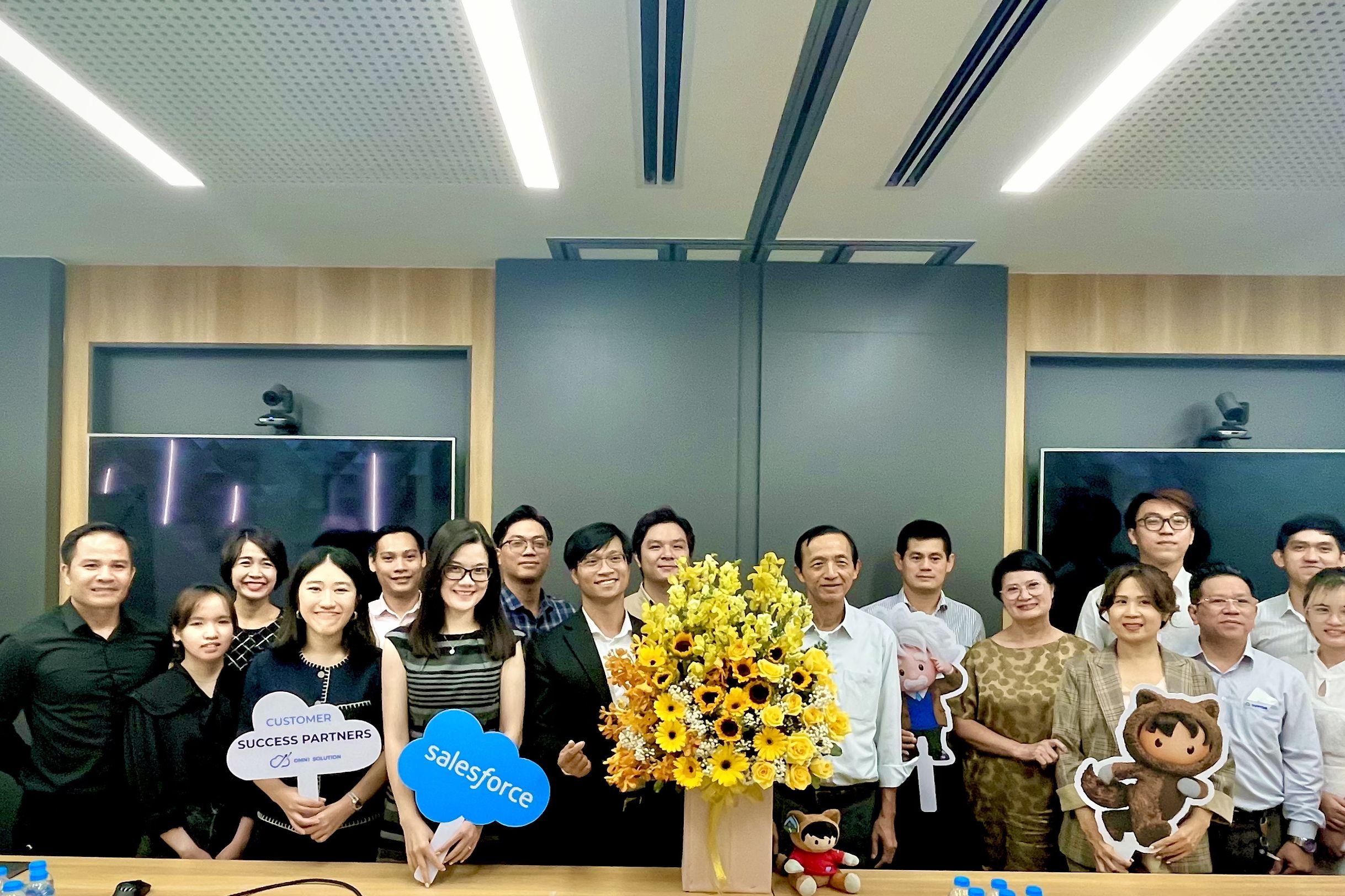
The kick-off ceremony for the “Salesforce CRM Phase 2 for British University Vietnam (BUV)” project was attended by BUV leadership, the OMN1 Solution team, and representatives from Salesforce.
The event marked not only the official launch of the project but also reinforced BUV’s long-term commitment to investing in technology, data, and operational excellence.
It also reflects the university’s strategic vision of building a modern admissions model powered by data and performance to support sustainable growth.
OMN1 Solution: Supporting Educational Institutions in Digital Transformation
With extensive experience delivering Salesforce solutions for enterprises and educational institutions in Vietnam, OMN1 Solution plays the role of strategic implementation partner in this project.
Beyond technology deployment, OMN1 focuses on:
- Understanding the unique operational challenges within education
- Designing solutions aligned with real-world admissions models
- Supporting workflow and operational performance optimization
- Building scalable long-term data foundations
The collaboration between BUV and OMN1 Solution represents how modern educational institutions are evolving — moving beyond process digitization toward performance- and data-driven operations.
Conclusion
The launch of the “Salesforce CRM Phase 2” project represents more than a CRM system upgrade for BUV. It is a key milestone in the university’s broader digital transformation strategy.
As higher education becomes increasingly competitive, institutions with the ability to operate flexibly, make faster decisions, and leverage data effectively will be best positioned to lead.
This project establishes a strong foundation for BUV to continue enhancing student experience, optimizing admissions operations, and preparing for future growth initiatives.